Quick answer
A taxi booking app in India costs about $4,800 to $8,300 (Rs 4 to 7 lakh) for a local fleet with its own drivers, $7,100 to $14,300 (Rs 6 to 12 lakh) for an outstation and rental booking platform, and $11,900 to $21,400+ (Rs 10 to 18 lakh+) for a multi-driver aggregator with live matching, surge pricing and driver payouts. Timelines run from about 10 weeks to 7 months.
Thinking about a cab app for your city, your travel agency or your fleet of cars? Quotes swing from Rs 50,000 “clone scripts” to Rs 50 lakh custom platforms, and most of that gap comes from one question: are you running your own cars, or matching many independent drivers?
This guide explains taxi booking app development cost in India for 2026 in plain numbers: the 3 business models, the 3 apps every cab business needs, the features that push cost up, the monthly running costs, and how to launch without burning the budget.
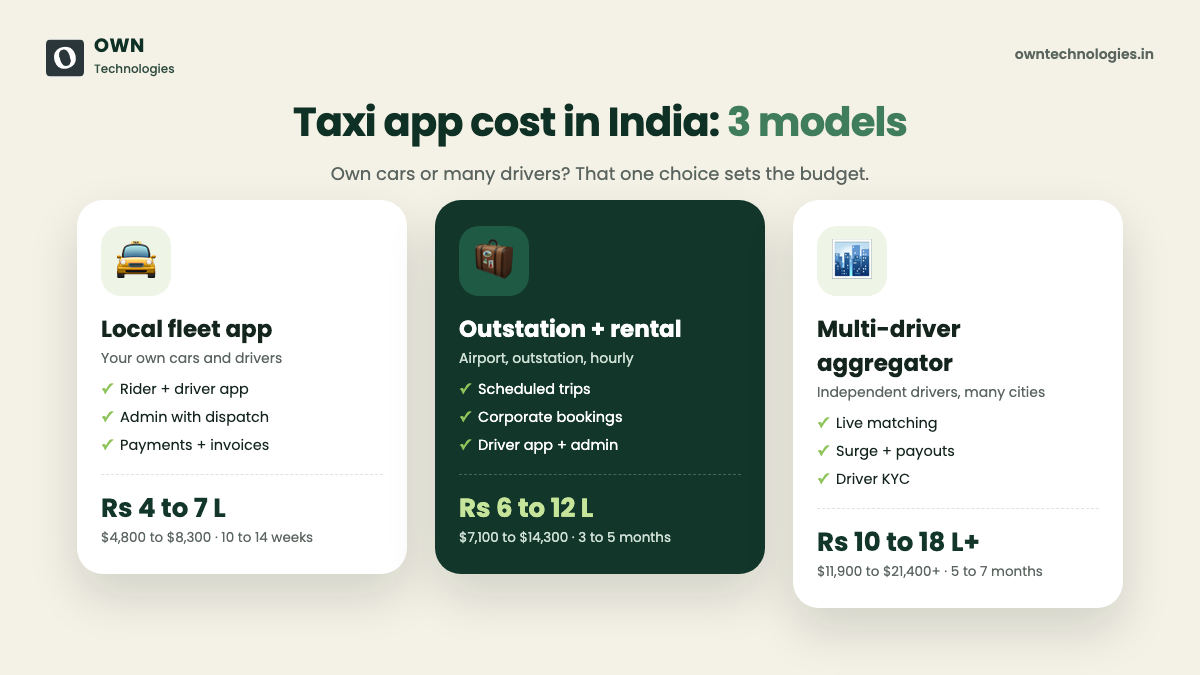
Taxi booking app development cost in India: 3 models
| Model | Who it suits | Apps you need | Cost (2026) | Timeline |
|---|---|---|---|---|
| Local fleet app | A taxi operator or travel agency with its own cars and salaried drivers | Rider app + driver app + admin panel | $4,800 to $8,300 (Rs 4 to 7 lakh) | 10 to 14 weeks |
| Outstation and rental platform | Airport transfers, outstation trips, hourly rentals, corporate bookings | Booking app or website + driver app + admin with scheduling | $7,100 to $14,300 (Rs 6 to 12 lakh) | 3 to 5 months |
| Multi-driver aggregator | Many independent drivers in one or more cities | Rider app + driver app with KYC + admin + live matching, surge, payouts | $11,900 to $21,400+ (Rs 10 to 18 lakh+) | 5 to 7 months |
Ranges assume a professional Indian team building with Flutter or React Native for Android and iOS, plus a web admin panel. USD figures use about Rs 84 to the dollar.
Key takeaway
If you own the cars, you do not need aggregator features like driver onboarding, surge pricing or commission payouts. Building only what your model needs can cut the budget in half.
The 3 apps inside every cab business
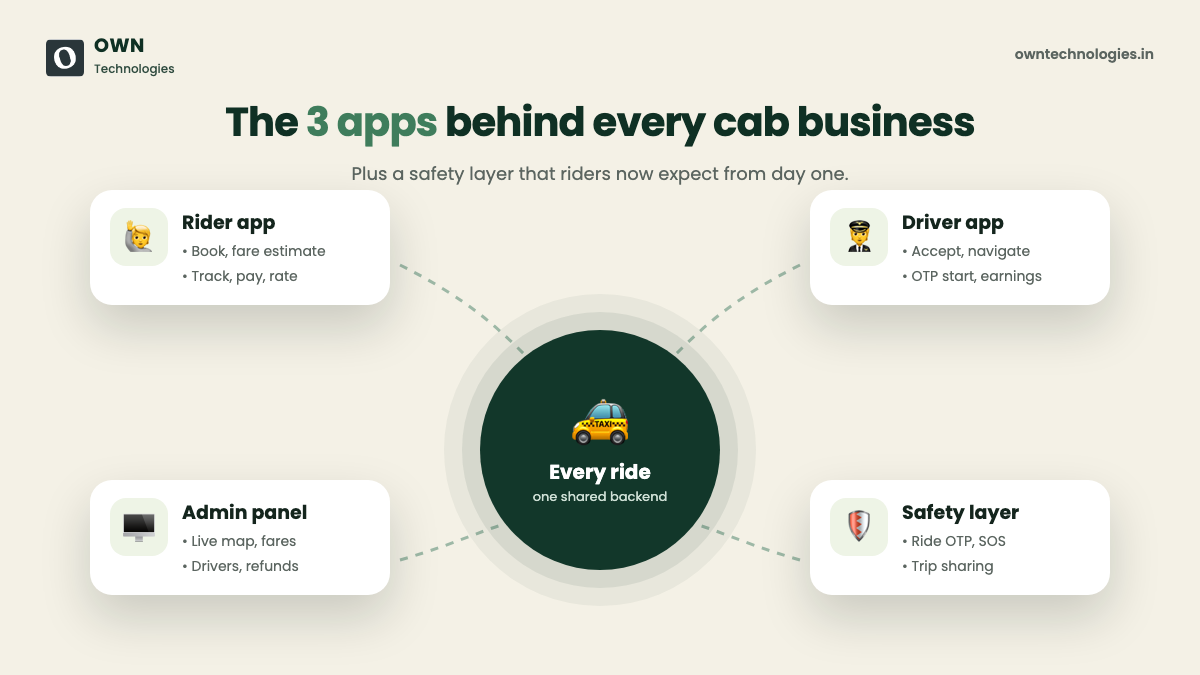
1. Rider app
- Sign up with mobile OTP, saved home and work addresses
- Pickup and drop on a map, fare estimate before booking
- Choose car type, ride now or schedule for later
- Pay by UPI, card, wallet or cash
- Live driver location, driver photo and car number, ride OTP
- Trip history, invoices, ratings and an SOS button
2. Driver app
- Go online or offline, accept or reject ride requests
- Navigation to pickup and drop
- Start the ride with the rider’s OTP, end the ride with the final fare
- Earnings for the day and week, cash collected
- Document upload for licence, RC and insurance (for aggregators)
3. Admin panel
- Live map of cars and rides
- Fare rules by city, car type, time and distance
- Drivers, vehicles, documents and approvals
- Riders, complaints, refunds and coupons
- Reports on rides, revenue and driver payouts
For a single fleet, much of the driver management stays simple because your drivers are already known to you. Our guide on what to include in admin panel version 1 shows how to keep the first version lean.
Features that push the cost up
| Feature | Adds roughly | Needed in V1? |
|---|---|---|
| Automatic nearest-driver matching | Rs 1.5 to 3 lakh | Yes for aggregators, optional for a small fleet |
| Surge or time-based pricing | Rs 60,000 to 1.5 lakh | Can wait |
| Driver KYC and document checks | Rs 80,000 to 2 lakh | Yes for aggregators |
| Driver payouts and commission split | Rs 1 to 2.5 lakh | Yes for aggregators |
| Scheduled and outstation trips | Rs 80,000 to 2 lakh | Yes for rental and outstation |
| Corporate accounts with monthly billing | Rs 1 to 2 lakh | Only for B2B |
| In-app calling with number masking | Rs 50,000 to 1 lakh | Strong for safety and privacy |
| Hindi or regional language | Rs 50,000 to 1.5 lakh | Yes in many cities |
Tip
Start with manual dispatch from the admin panel if you have fewer than about 30 cars. A dispatcher assigning rides is cheaper to build and easier to control than automatic matching, and you can add matching later.
Monthly running costs after launch
The app is a one-time cost. These keep running every month:
- **Maps and location:** fare estimates, live tracking and routes use map APIs billed per request after a free monthly allowance. Check the Google Maps Platform pricing page for current rates. Live tracking is usually the biggest map cost, so update locations every few seconds, not every second.
- **Payment gateway fees:** for example, Razorpay’s standard pricing lists 2% on domestic transactions, plus GST.
- **SMS OTP and notifications** for login, ride OTPs and trip updates.
- **Cloud hosting and database,** which grows with rides and live location data.
- **Masked calling,** if riders and drivers call each other through the app.
- **Maintenance:** OS updates, bug fixes and small changes. See our breakdown of app maintenance cost in India and the UAE.
Example budget: a 40-car city taxi operator
Here is how a local fleet app could be budgeted. This is an illustration, not a quote, and your scope will change the numbers.
| Item | Example cost |
|---|---|
| Rider app (Android + iOS, one codebase) | Rs 1,80,000 |
| Driver app | Rs 1,20,000 |
| Admin panel with live map, fares and manual dispatch | Rs 1,30,000 |
| Payments, invoices and ride OTP | Rs 50,000 |
| Scheduled airport and outstation trips | Rs 70,000 |
| Testing, store launch and staff training | Rs 50,000 |
| **Total** | **Rs 6,00,000 (about $7,100)** |
Key takeaway
The rider and driver apps share one backend. Paying for both apps from the same team, in one codebase, is what keeps a fleet app in the Rs 4 to 7 lakh range.
Safety, licensing and trust
Cab apps carry real responsibility for riders and drivers. Build these in from version 1:
- **Ride OTP** so the rider gets into the right car
- **Driver photo, car number and live tracking** shared before pickup
- **SOS button and trip sharing** with a family member
- **Driver document records** with expiry reminders for licence and insurance
- **Clear fare breakdown** and digital invoices for every trip
If you plan to run as an aggregator, check the Motor Vehicle Aggregator Guidelines, 2020 issued by the Ministry of Road Transport and Highways, along with your state’s rules, before launch. Licensing needs differ by state, so speak to a transport lawyer early.
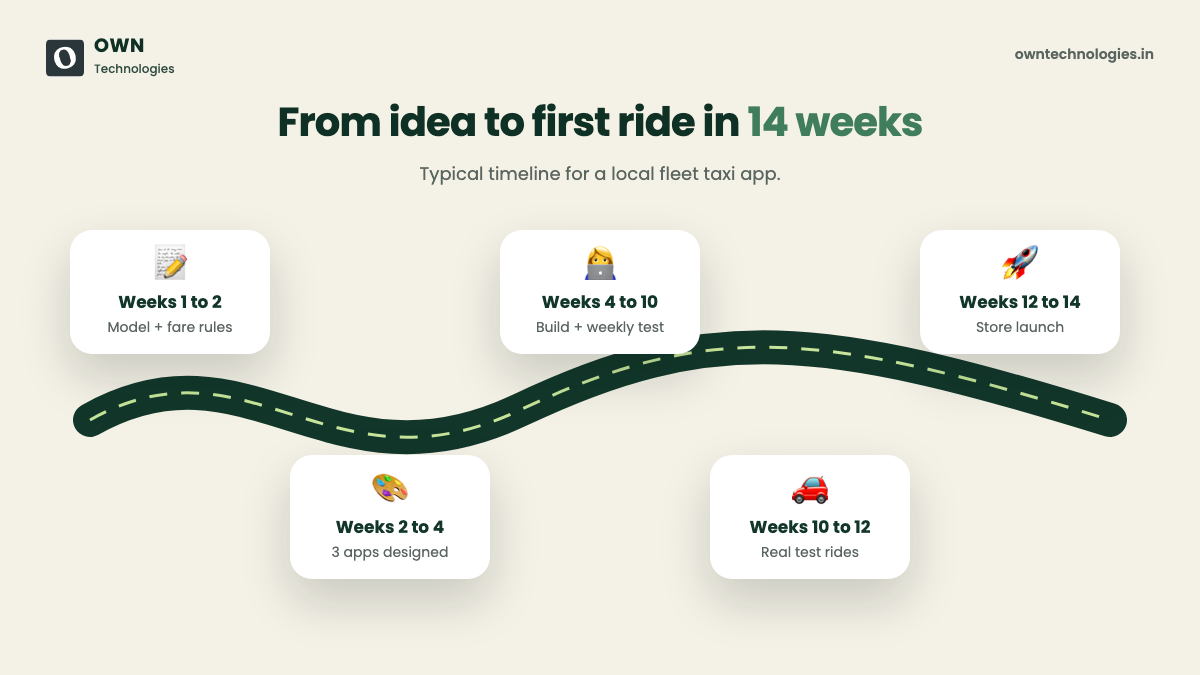
Timeline: from idea to first ride
- **Weeks 1 to 2:** business model, fare rules, cities and screens agreed.
- **Weeks 2 to 4:** design of rider app, driver app and admin panel.
- **Weeks 4 to 10:** build, with a test app on your phone every week.
- **Weeks 10 to 12:** real test rides with your own drivers in one area.
- **Weeks 12 to 14:** Play Store and App Store launch, driver training and first fixes.
For a step-by-step plan of how we run builds like this, see our MVP app in 8 weeks guide.
5 ways to keep your cab app budget under control
- **Pick one model.** A fleet app and an aggregator are different products. Do not pay for both on day one.
- **Launch in one city or one zone.** Fares, drivers and support are easier to get right in one area.
- **Use one cross-platform codebase** for Android and iOS rider and driver apps. Our Flutter vs React Native comparison explains the trade-offs.
- **Start with manual dispatch** if your fleet is small, then add automatic matching.
- **Avoid cheap clone scripts** you cannot change. Ask who owns the code and whether it can be extended.
How to choose a taxi app development company in India
Ask these questions before you sign:
- Can you show live apps with real-time tracking that you built?
- Are the rider app, driver app and admin panel all in the quote?
- Who owns the source code, the app store accounts and the server?
- Which map, SMS and payment providers will you use, and who pays their bills?
- How do you test live tracking and payments before launch?
- What does a monthly support plan cover?
At OwnTechnologies, we have delivered 100+ projects over 8+ years, including apps with 10M+ downloads. See our portfolio, our Flutter development services and CRM development if you also want to manage corporate clients and bookings in one place.
Frequently Asked Questions
A local fleet app costs about Rs 4 to 7 lakh ($4,800 to $8,300). An outstation and rental platform costs about Rs 6 to 12 lakh. A multi-driver aggregator with live matching, surge pricing and payouts costs Rs 10 to 18 lakh or more.
A fleet app takes about 10 to 14 weeks. An outstation and rental platform takes 3 to 5 months. An aggregator with driver onboarding, matching and payouts takes about 5 to 7 months.
You can build the same core idea, but not the same scale on day one. Start with one city, a rider app, a driver app and an admin panel, then add automatic matching, surge pricing and more cities as rides grow.
Yes. Riders and drivers need different screens and permissions, so they get separate apps. Both apps can share one backend and one codebase framework to keep costs down.
Expect map and location charges, payment gateway fees, SMS OTP costs, cloud hosting, masked calling if used, and a maintenance plan for updates and fixes.
A script can be cheaper upfront, but check who owns the code, whether you can change it, and how it handles security and updates. Many businesses pay twice when a script cannot grow with them.
Ride OTP, driver photo and car number before pickup, live trip tracking, trip sharing with family, an SOS button and verified driver documents.
Final Thoughts
Taxi booking app development cost in India depends mainly on one choice: your own fleet, an outstation and rental platform, or a multi-driver aggregator. Pick the model that matches how you run cars today, launch in one area, and add matching, surge pricing and new cities with real ride data.
Want a fixed quote for your cab app? Share your fleet size, cities and must-have features, and we will send a clear plan with cost and timeline. Book a free consultation with OwnTechnologies.