Quick answer
Tiffin subscription app cost in India is about $3,600 to $6,500 (Rs 3 to 5.5 lakh) for one tiffin service or cloud kitchen, $7,100 to $13,100 (Rs 6 to 11 lakh) for a multi-kitchen meal plan app with a rider app and corporate billing, and $14,300 to $28,600+ (Rs 12 to 24 lakh+) for a marketplace of home cooks. Most first versions go live in 8 weeks to 5 months.
Running a tiffin service on WhatsApp, a notebook and a stack of UPI screenshots? It works for 30 customers. At 150, the daily questions start to hurt: who skipped tomorrow’s lunch, who has paid for the month, which rider takes which lane, and how many rotis the kitchen should make.
This guide explains tiffin and meal subscription app cost in India for 2026 in plain numbers. You will see the 3 types of app, the 4 parts every tiffin app needs, the features that save the most time, monthly running costs, an example budget, a 12-week timeline, and how to choose a developer.
Tiffin / meal subscription app cost in India: 3 types
| App type | Who it suits | What you get | Cost (2026) | Timeline |
|---|---|---|---|---|
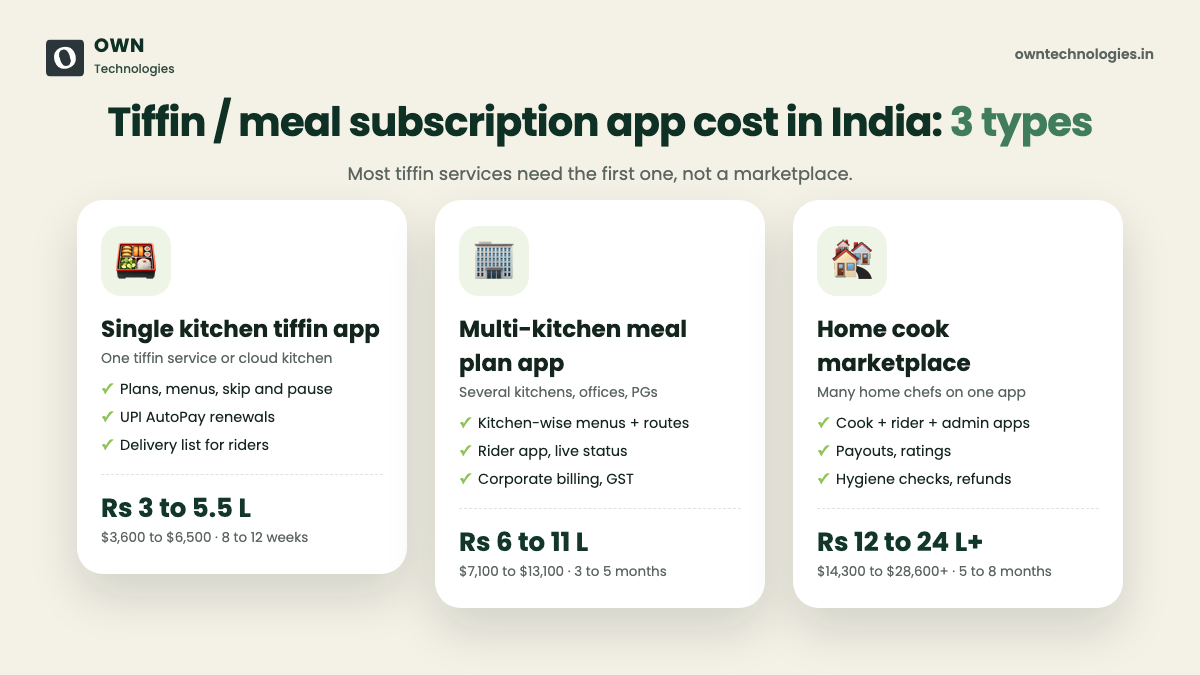
| Single kitchen tiffin app | One tiffin service, home kitchen or cloud kitchen | Plans and menus, skip and pause, UPI AutoPay renewals, delivery list, admin panel | $3,600 to $6,500 (Rs 3 to 5.5 lakh) | 8 to 12 weeks |
| Multi-kitchen meal plan app | Several kitchens, office meal plans, PG and hostel food | Everything above + kitchen-wise menus, rider app, routes by area, corporate billing with GST | $7,100 to $13,100 (Rs 6 to 11 lakh) | 3 to 5 months |
| Home cook marketplace | Many home chefs on one app | Customer app, cook app, rider app, admin, payouts, ratings, hygiene checks, refunds | $14,300 to $28,600+ (Rs 12 to 24 lakh+) | 5 to 8 months |
Ranges assume a professional team, Android and iOS from one cross-platform codebase, and a web admin panel. USD figures use about Rs 84 to the dollar.
Key takeaway
Most tiffin services do not need a marketplace. A branded app for your own kitchen fixes the daily mess of skips, renewals and delivery lists, and your customer list stays with you.
Why a subscription app is different from a food delivery app
A food delivery app sells one order at a time. A tiffin app sells a plan: 22 lunches a month, dinner on weekdays, or a diet meal for 4 weeks. That changes how the app is built.
- The calendar is the product. Every customer has a meal calendar with days on, days off, skips and holidays. The kitchen reads tomorrow’s count from it.
- Payments repeat. Renewals run every week or month, so the app needs auto-debit, reminders and a clear record of what each customer has paid.
- Credits matter. When a customer skips a meal before the cut-off time, they expect a credit or an extra day. The rules must be in the app, not in your head.
- Delivery is a route, not a trip. Riders carry 20 to 40 tiffins on a fixed route, and steel tiffins often come back the next day.
If you start from a food delivery template, you will spend most of the budget bending it into a subscription app. It is cheaper to plan for subscriptions from day one. Our restaurant app cost guide for India covers the one-order model if that is closer to your business.
The 4 parts of a tiffin subscription app
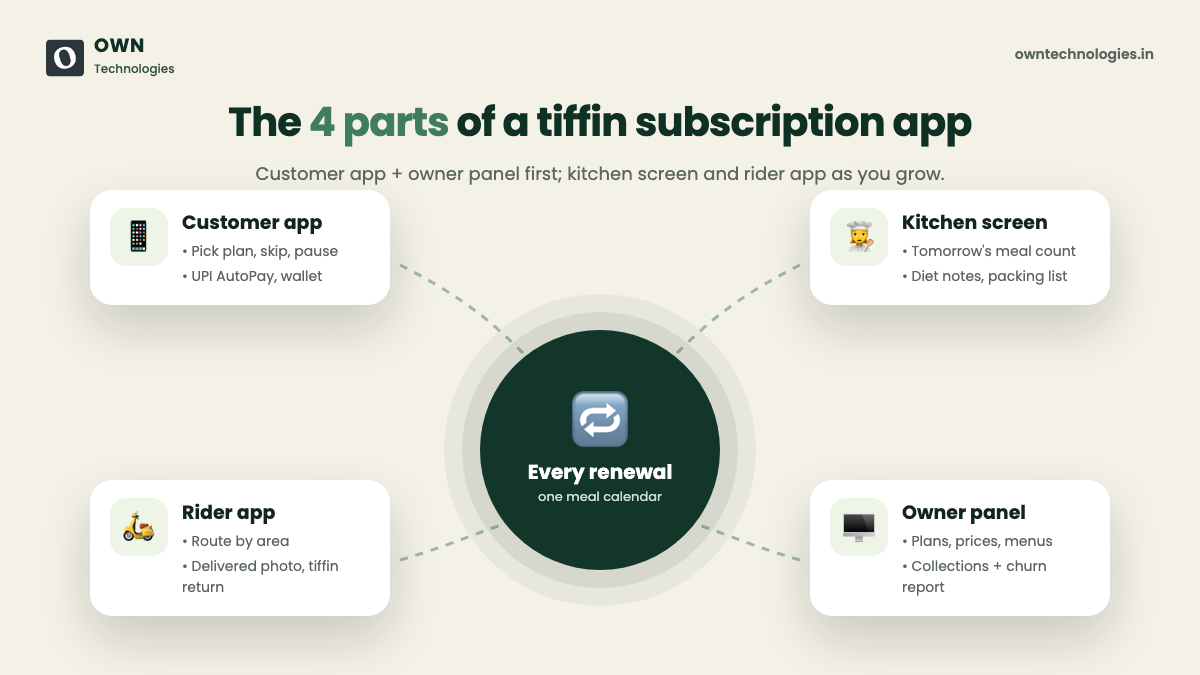
1. Customer app
Customers pick a plan, choose veg or non-veg, add extras like rotis or curd, and set their delivery address. The most used button is Skip tomorrow. Next come pause for a trip, renew, and see what is on the menu.
2. Kitchen screen
A simple screen or printout that shows tomorrow’s meal count by plan, special diet notes, and packing labels by area. This alone can save the owner an hour every evening.
3. Rider app
Riders see their route by area, mark each tiffin as delivered with a photo if needed, and record empty tiffins collected. If you use only 1 or 2 riders, a printed list from the admin panel can stand in for this app in version 1.
4. Owner panel
The owner sets plans, prices and menus, sees who has paid and who is due, and tracks how many customers renewed this month. That renewal number tells you more about the business than any other.
Features that save the most time
- Skip and pause with a cut-off time. For example, skips allowed until 9 PM for the next day’s lunch. Credits are added on their own.
- UPI AutoPay renewals. Payment gateways such as Razorpay Subscriptions support UPI AutoPay and e-mandates for repeat payments, so you stop chasing customers on the 1st of every month.
- Tomorrow’s count by plan. The kitchen knows exactly how much to cook, which cuts waste.
- Area-wise delivery list. Sorted by lane or society, so a new rider can follow it on day one.
- Menu of the week. Customers see what is coming and are less likely to skip.
- Reminders before renewal. A push or SMS 3 days before the plan ends keeps renewals high.
- Simple GST invoices. Useful for office customers who need a bill every month.
Tip
Write down your skip, pause and refund rules before design starts: the cut-off time, how many skips per month, and whether credits expire. Clear rules shown in the app stop most arguments with customers.
Features that push the cost up
These are useful, but each one adds weeks. Leave them for version 2 unless your business depends on them.
- Live rider tracking on a map for every delivery
- Diet and calorie plans with nutritionist input and custom meals per customer
- Corporate accounts with many employees, one bill and per-employee limits
- Multiple kitchens with menus and stock tracked separately
- Home cook onboarding with document checks, payouts and ratings (the marketplace model)
- Wallet and referral system with cashback rules
- Hindi or regional language versions of the app
Monthly running costs after launch
| Cost | Typical range | Notes |
|---|---|---|
| Cloud hosting and database | Rs 2,000 to 8,000 a month | Grows with customers and photos |
| SMS and push notifications | Rs 500 to 3,000 a month | Push is nearly free; SMS costs per message |
| Payment gateway fees | Around 2% per transaction on standard plans | Check your gateway’s current pricing page |
| Maps API (only if you use live tracking) | Rs 0 to 5,000 a month | Depends on usage |
| Maintenance and small updates | 15% to 20% of build cost per year | Bug fixes, OS updates, small changes |
| Play Store and App Store accounts | US$25 once for Google Play, US$99 a year for Apple | Paid in your company’s name |
Razorpay lists a standard fee of 2% per transaction on its pricing page, and Google charges a one-time US$25 to open a Play Console developer account. For a full breakdown of yearly upkeep, see our guide to app maintenance cost in India and the UAE.
Example budget: a tiffin service with 300 customers
Here is an illustrative budget for one kitchen in a large city serving about 300 lunch and dinner customers with 4 riders.
| Item | Estimate |
|---|---|
| Customer app (Android + iOS, one codebase) | Rs 1.8 to 2.6 lakh |
| Owner panel with plans, payments and reports | Rs 0.8 to 1.2 lakh |
| Kitchen count and area-wise delivery list | Rs 0.4 to 0.6 lakh |
| UPI AutoPay and invoice setup | Rs 0.3 to 0.5 lakh |
| Testing and store launch | Rs 0.3 to 0.6 lakh |
| Total | Rs 3.6 to 5.5 lakh |
Key takeaway
This kitchen skips live tracking and a rider app in version 1. Skips, renewals and tomorrow’s count are what save time every single day, so that is where the money goes first.
Timeline: from menu card to first renewal
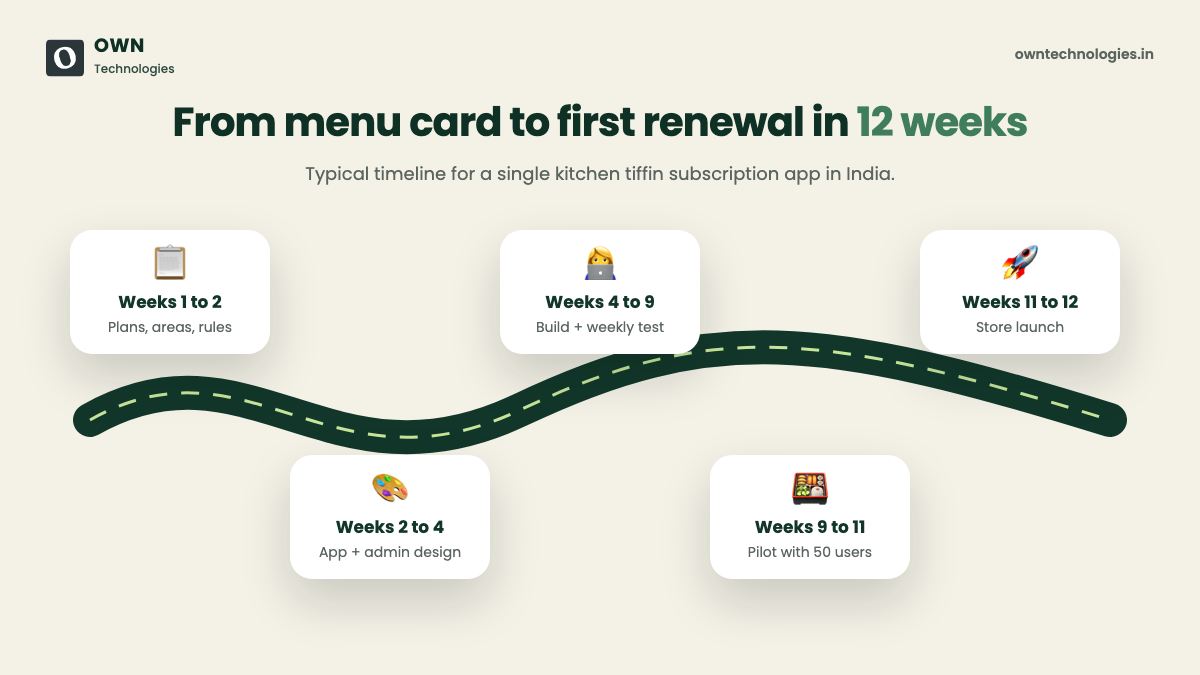
- Weeks 1 to 2: plans, areas and rules. List every plan, price, delivery area, cut-off time and skip rule.
- Weeks 2 to 4: design. Screens for the customer app and the owner panel, checked on real phones.
- Weeks 4 to 9: build and weekly testing. You see working screens every week, not only at the end.
- Weeks 9 to 11: pilot. Move about 50 loyal customers to the app first and fix what confuses them.
- Weeks 11 to 12: launch. Publish on Play Store and App Store and move the rest of your customers.
How to move customers from WhatsApp to the app
The app only works if customers use it. These steps help.
- Start with your regulars. They trust you and will tell you what is wrong.
- Make skipping easier in the app than on WhatsApp. Once customers can skip in 2 taps and see the credit, they stop messaging.
- Give a small reason to switch. For example, one free meal on the first renewal through the app.
- Keep a web link for older customers. Some parents and senior citizens prefer a simple web page to an app. Our web development team can add a light web version on the same backend.
- Get found on Google too. A good app does not replace local search. Our SEO services help tiffin and food businesses show up for searches like “tiffin service near me”.
5 mistakes that make tiffin apps cost more
- Copying a food delivery app. Subscriptions, skips and credits then get forced in later at high cost.
- No written rules. If the skip and refund rules change during the build, screens get rebuilt.
- Building a marketplace first. You pay for cook onboarding and payouts before proving that your own kitchen works on an app.
- Live tracking in version 1. Riders on fixed routes rarely need it at the start.
- No owner reports. Without renewal and payment reports, you are still running the business from a notebook.
How to choose a tiffin app developer in India
| Question to ask | Good answer |
|---|---|
| Have you built subscription or booking apps? | Shows real examples, not only templates |
| Who owns the code and store accounts? | You do, in your company’s name |
| Will I see progress every week? | Yes, with a test build you can install |
| What is the fixed price for version 1? | A written scope with a fixed cost and timeline |
| What happens after launch? | A clear maintenance plan with a monthly or yearly cost |
At OwnTechnologies, we have delivered 100+ projects over 8+ years for clients in India and the UAE, including ordering and booking apps. See our portfolio and our Flutter development services for one codebase on Android and iOS. Selling groceries too? Read our guide to grocery delivery app development cost in India.
Frequently Asked Questions
A tiffin or meal subscription app for one kitchen costs about Rs 3 to 5.5 lakh ($3,600 to $6,500). A multi-kitchen app with a rider app costs about Rs 6 to 11 lakh, and a home cook marketplace starts around Rs 12 lakh.
A single kitchen app takes about 8 to 12 weeks. A multi-kitchen app takes 3 to 5 months, and a marketplace takes 5 to 8 months.
Yes. Payment gateways in India support UPI AutoPay and e-mandates for subscriptions, so renewals can be collected automatically after the customer approves the mandate once.
Yes. A good tiffin app lets customers skip a day or pause for a trip before a cut-off time, and adds a credit or extra day based on your rules.
Not always. With 1 or 2 riders on fixed routes, an area-wise delivery list from the owner panel is often enough. Add a rider app when you grow.
Expect hosting of about Rs 2,000 to 8,000 a month, SMS costs, payment gateway fees of around 2% per transaction on standard plans, and yearly maintenance of 15% to 20% of the build cost.
Ready-made software is fine to test the idea. Build your own app when you want your own brand, your own rules for skips and credits, and full control of your customer list.
Final Thoughts
Tiffin and meal subscription app cost in India depends mostly on scope. Start with one kitchen, get skips, renewals and tomorrow’s count right, and add live tracking, diet plans and a marketplace only when the numbers ask for them.
Want a fixed quote for your tiffin app? Share your plans, delivery areas and customer count, and we will send a clear plan with cost and timeline. Book a free consultation with OwnTechnologies.