“Add AI” is now on almost every founder’s feature list in India. The trouble is that the quotes make little sense. One developer says Rs 50,000, another says Rs 25 lakh, and both are talking about “a chatbot”.
This guide breaks AI app development in India down by feature. You will see what each common AI feature costs to build in rupees, what it costs every month to run, with a worked example, and how to tell which features are worth paying for. If you want a broader view of what businesses are building, read our guide to [AI app development in 2026](https://blog.owntechnologies.in/ai-app-development-2026/).
The short answer
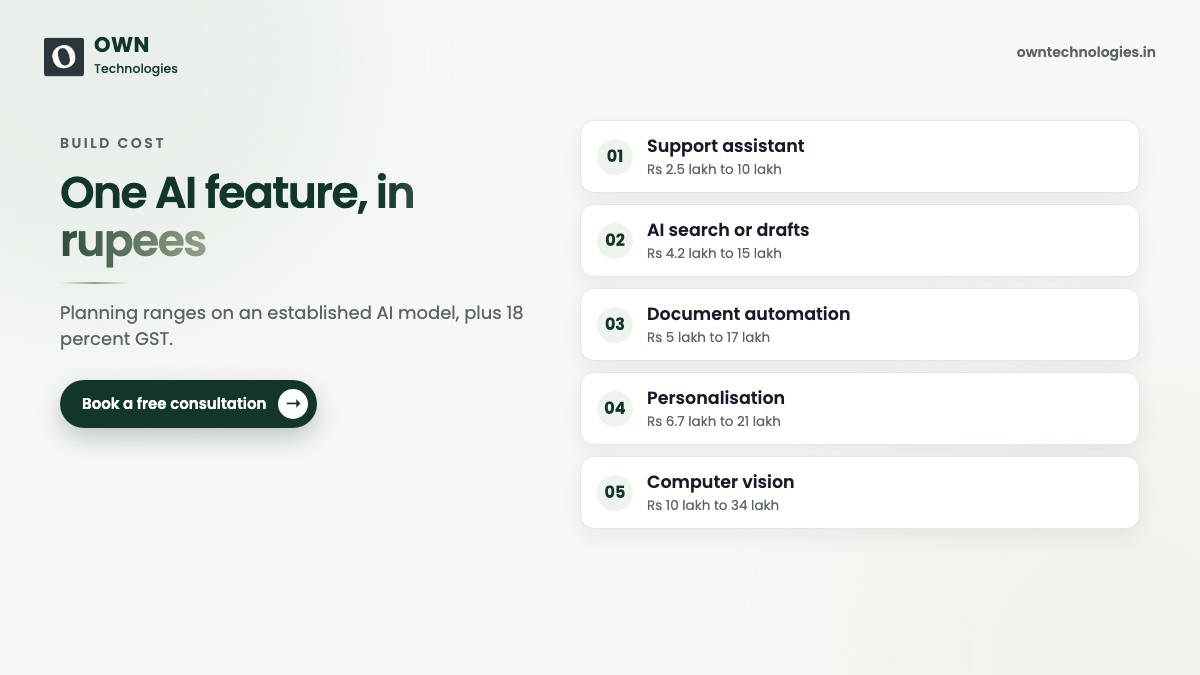
Adding one AI feature to an existing app usually costs Rs 2.5 lakh to Rs 21 lakh in India when it is built on an established AI model, not trained from scratch. A custom model trained on your own data starts at around Rs 34 lakh and can go higher. On top of the build, you pay a monthly running cost that grows with usage.
| AI feature | What it does | Typical build cost | Typical timeline |
|---|---|---|---|
| Support assistant | Answers FAQs, checks status, books appointments | Rs 2.5 lakh to 10 lakh | 2 to 5 weeks |
| AI search or content drafts | Plain-language search, auto-written drafts | Rs 4.2 lakh to 15 lakh | 3 to 6 weeks |
| Document automation | Reads invoices, forms and contracts | Rs 5 lakh to 17 lakh | 3 to 7 weeks |
| Personalisation | Recommends products, listings or content | Rs 6.7 lakh to 21 lakh | 4 to 8 weeks |
| Predictions | Forecasts churn, demand or lead quality | Rs 8.4 lakh to 25 lakh | 5 to 10 weeks |
| Computer vision | Image checks, defect flags, stock counts | Rs 10 lakh to 34 lakh | 6 to 12 weeks |
These are planning ranges converted from our US dollar ranges at Rs 84 to the dollar. Add 18 percent GST. The exact figure depends on your data, your integrations and how accurate the feature has to be.
Why two quotes for “a chatbot” can differ 50 times
A low quote and a high quote are often for different products.
- **A wrapper.** A chat box connected to an AI model, with a short instruction. It takes days to build. It also makes up answers about your prices and policies, because it knows nothing about your business.
- **A grounded assistant.** It answers from your own documents and data, says “I do not know” when it should, and hands over to a person. This is what most businesses actually need, and most of the budget goes into data preparation and testing.
- **An assistant that takes actions.** It books appointments, checks orders and updates your CRM. Every action needs an integration, permissions and safeguards, so this is the most expensive of the three.
Before you compare prices, ask each vendor which of these three they are quoting for.
What drives the build cost
Your data
This is usually the biggest factor. If your FAQs, product details and policies are in clean, current documents, the work is straightforward. If they are spread across WhatsApp chats, PDFs and one employee’s memory, cleaning them comes first.
Integrations
An assistant that reads from a static document is cheap. One that checks live order status needs access to your backend. Every system it connects to, such as your CRM, payment gateway or booking calendar, adds work.
Languages
Many Indian customers do not write in formal English. They write in Hindi, in regional languages and in Hinglish typed in Roman script. Test with real customer messages from your own support chats, and budget time for fixing what fails. Do not accept a demo that only uses clean English.
Accuracy and safety
A wrong movie recommendation is harmless. A wrong answer about a refund, a medicine or a loan is not. The higher the cost of a mistake, the more you spend on testing, guardrails and human review.
The admin side
Your team will need a screen to see conversations, correct answers and update content. Without it, every small change becomes a developer request. Our guide to [admin panels for version 1](https://blog.owntechnologies.in/admin-panel-development-version-1/) covers what to include.
The monthly running cost: a worked example
Most AI features are billed per use, by “tokens”, which are small chunks of text. This is the part founders most often forget. Here is a simple estimate for a support assistant.
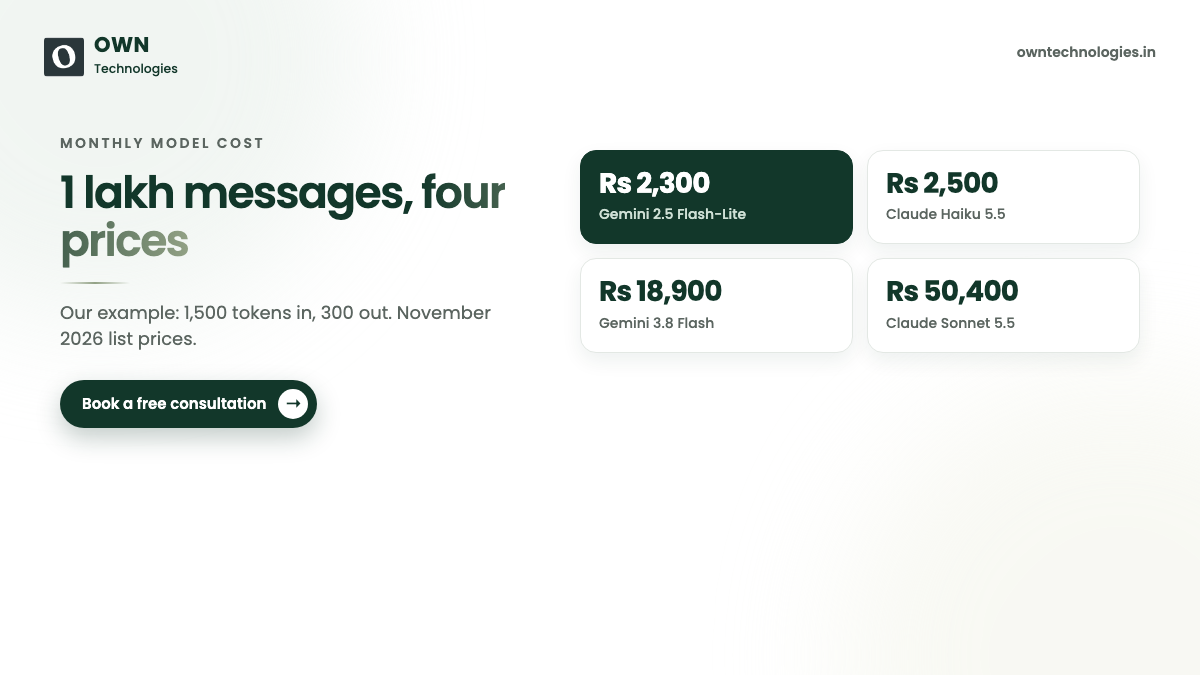
Assume 1 lakh messages a month, with about 1,500 tokens going in (the question plus context from your documents) and 300 tokens coming out (the answer). That is 150 million input tokens and 30 million output tokens a month.
| Model (published price per million tokens) | Input | Output | Monthly model cost | In rupees |
|---|---|---|---|---|
| Google Gemini 2.5 Flash-Lite | $0.10 | $0.40 | $27 | about Rs 2,300 |
| Anthropic Claude Haiku 5.5 | $0.10 | $0.50 | $30 | about Rs 2,500 |
| Google Gemini 3.8 Flash | $0.75 | $3.75 | $225 | about Rs 18,900 |
| Anthropic Claude Sonnet 5.5 | $2.00 | $10.00 | $600 | about Rs 50,400 |
Prices are from the public pricing pages of Google and Anthropic as of November 2026, at Rs 84 to the dollar, before GST. They change often, and Google has announced that the Gemini 3.8 Flash price will double from 1 January 2027, so recheck them before you commit.
Two lessons come out of this table:
- **The same feature can cost 20 times more depending on the model.** Start with the cheapest model that passes your tests, and use a stronger one only for the hard questions.
- **Model cost is often not the largest monthly cost.** Servers, monitoring, human review and ongoing improvements can be larger. Keep a separate budget for them, plus yearly maintenance of about 15 to 20 percent of the build cost.
Buy, connect or build?
Not every AI need should become a custom project.
| Option | Best for | Watch out for |
|---|---|---|
| Ready-made tool | Standard needs like website chat or call summaries | Per-seat fees, limited control, your data on their platform |
| Build on an existing AI model | Features tied to your data or workflow | Needs good data and testing, plus running costs |
| Train your own model | Unique data and large volume | High cost, specialist team, months of work |
For most Indian businesses, the first project should be the first or second option. Training your own model rarely makes sense until you have real usage and a clear reason.
Rules to plan for in India
India’s Digital Personal Data Protection Act applies when your app handles personal data. The DPDP Rules were notified in November 2025 with a phased rollout, and most core duties such as notice, consent and security safeguards are due about 18 months after notification. The government has discussed shortening this window, so check the current position with your legal adviser.
In practical terms, for an AI feature:
- Tell users when they are talking to AI, and what data you collect.
- Send the AI only the data it needs. Remove phone numbers, ID numbers and health details where you can.
- Check your AI provider’s terms on data storage and on using your data for training.
- Keep logs so you can investigate a wrong answer.
- Get specific legal advice for health, finance and children’s apps.
Which AI features are usually worth it first
In our view, a good first AI feature has three things: a high volume of repetitive work, a measurable result, and a low cost when it is occasionally wrong.
- **Support assistant:** if a large share of your messages are the same few questions.
- **Document automation:** if staff retype invoices or forms all day.
- **Lead scoring or summaries:** if your sales team spends time on poor leads.
Be careful with features that exist only because AI is fashionable. If you cannot name the number it will improve, wait.
How to start without wasting money
- **Pick one use case and one number,** such as “reduce repeat support messages”.
- **Collect 100 real examples** from your support chats, forms or documents. These become your test set.
- **Build a small prototype, 2 to 3 weeks.** Test it against those examples before you touch your live app.
- **Launch to a small group** with a human fallback, and read the conversations.
- **Then expand,** add languages and integrations, and move simple work to cheaper models.
Common mistakes
- **Launching with no way to reach a human.** Frustrated customers leave.
- **Measuring usage and not results.** Ten thousand chats mean nothing if tickets did not fall.
- **No spending limit.** Set usage caps and alerts so a bug or abuse cannot run up a large bill.
- **Locking into one AI provider.** Prices change fast, so design the app so the model can be swapped.
- **Skipping the test set.** Without one, every “improvement” is a guess.
Questions to ask an AI development company
- Which of your live projects use AI, and can I see one?
- Will the assistant answer from my data, and what does it do when it does not know?
- How will you test accuracy, in my customers’ languages?
- What will it cost per month at my expected usage?
- Can we switch AI models later without rebuilding?
- Who owns the code, the prompts and the data?
For general checks on any vendor, see our guide to [choosing a mobile app development company in India](https://blog.owntechnologies.in/best-mobile-app-development-company-india/). For non-AI budgets, see [custom software development costs in India](https://blog.owntechnologies.in/custom-software-development-cost-india/).
Frequently Asked Questions
Adding one AI feature to an existing app usually costs Rs 2.5 lakh to Rs 21 lakh when it uses an established AI model, plus 18 percent GST. Predictions and computer vision can cost more, and a custom-trained model starts at around Rs 34 lakh.
In our worked example of 1 lakh messages a month, the model cost ranges from about Rs 2,300 to Rs 50,400 depending on the model. Servers, monitoring and human review are extra.
Usually not. Most business features work well on an established model that reads your own data. Train your own only with unique data, large volume and a clear reason.
Yes, but test them with real customer messages, including Hinglish typed in Roman script. Quality varies by language and model, so do not rely on an English demo.
A focused feature on an established model usually takes 2 to 8 weeks. Predictions and computer vision can take 5 to 12 weeks, depending on your data.
It depends on the provider’s terms and on what you send them. Send only the data you need, remove sensitive details where you can, check how the provider stores data, and follow India’s DPDP rules.
Final Thoughts
The cost of AI in an app is not really about the AI. It depends on your data, your integrations and how much a wrong answer would hurt you. Start with one repetitive job and one number, test against real examples, and watch your monthly bill from the first day.
Thinking about adding AI to your app or business? Our AI development team in Gurugram will review your use case and send a written scope with a cost range in INR. Book a free consultation to get started.