

Migrating legacy software is a critical step in modernizing your business infrastructure. If your current system is outdated, slow, or incompatible with new technologies, partnering with a trusted Delhi-based development team like OwnTechnologies can help streamline the process effectively.
In this blog, we’ll walk you through how to migrate legacy software with a Delhi-based development team, supported by real case studies, client testimonials, and expert guidance.
Why Migrate Legacy Software?
Legacy systems often lack flexibility, performance, and integration capabilities. Here’s why migration is important:
- Security Improvements
- Cloud Compatibility
- Scalability & Performance
- Reduced Maintenance Cost
Benefits of Choosing a Delhi-Based Team
Delhi is home to some of India’s most talented and experienced developers. When you work with OwnTechnologies, you benefit from:
- Affordable pricing
- Time zone compatibility with global clients
- Agile development process
- Dedicated post-launch support
Step-by-Step Guide to Legacy Software Migration
- System Audit & Requirement Gathering
- Understand what parts of the legacy system are essential.
- Define the Migration Strategy
- Rehost, Refactor, Re-architect, or Rebuild.
- Choose the Right Tech Stack
- Modern, scalable, and secure technologies (React, Node.js, etc.)
- Develop & Test Modules
- Gradual rollout with automated and manual testing.
- Data Migration & Validation
- Securely transfer and validate existing data.
- Deployment & Maintenance
- Go live with full support and continuous monitoring.
📂 Case Study: Manufacturing ERP Migration
Client: A mid-sized Delhi-based manufacturing firm
Challenge: Legacy desktop ERP in VB6 and MS Access
Solution: Rebuilt in Node.js and React with cloud-based MongoDB
Result: 65% improvement in performance, 80% fewer errors, and real-time access for multiple users.
💬 Testimonial
“OwnTechnologies transformed our 15-year-old ERP system into a fast, mobile-friendly web app. We saved costs and scaled faster than ever before. Highly recommend their Delhi team!”
— Rohit Sharma, Operations Head
✅ Why OwnTechnologies?
- Over 50+ legacy migrations completed
- Domain expertise in manufacturing, fintech, healthcare
- Delhi-based team with global delivery standards
- Transparent communication and milestone-based billing
🎯 Call to Action
Want to modernize your old software? Book a free consultation with OwnTechnologies today!
🙋♂️ FAQs
Q1: How long does legacy software migration take?
A: It typically ranges from 4 to 12 weeks depending on the complexity.
Q2: Will my data be safe during migration?
A: Absolutely. We follow encrypted and validated data transfer protocols.
Q3: Can we migrate only part of the system?
A: Yes, we can perform phased migration for minimal disruption.
Q4: Do you offer ongoing support?
A: Yes, 3–6 months of free maintenance is included with all migration packages.
Still using outdated systems? Let’s bring your software into the future with OwnTechnologies — your trusted Delhi-based software development team.
🔗 Visit OwnTechnologies.in for more case studies, services, and success stories.


Great point about using modern stacks like React and Node.js. Curious to know how often teams go for a full rebuild versus a refactor when working with older systems—that tradeoff can really define the project’s scope and success.
Thanks! That’s a great question—and you’re absolutely right, the decision between a full rebuild and a refactor is critical.
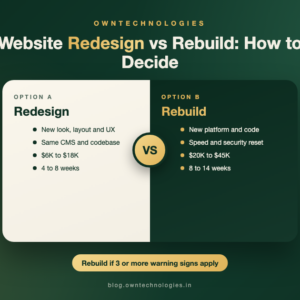
In our experience at OwnTechnologies, it often depends on a few key factors like the existing architecture’s flexibility, long-term goals, and how tightly coupled the legacy system is. If the old codebase is too rigid or incompatible with modern practices (e.g., missing APIs, outdated tech), teams lean toward a full rebuild. But when there’s a stable foundation, a phased refactor using modern stacks like React and Node.js can reduce risk and allow for smoother transitions.
We usually start with a code audit to decide what’s salvageable—and often, a hybrid approach ends up being the smartest path.
Happy to dive deeper into real-world examples if you’re interested!
The clear breakdown of the migration process, from auditing the system to choosing the right tech stack, makes this a great resource for anyone looking to modernize their software. Also, working with a Delhi-based team offers some unique advantages, particularly in terms of cost-efficiency and flexibility.