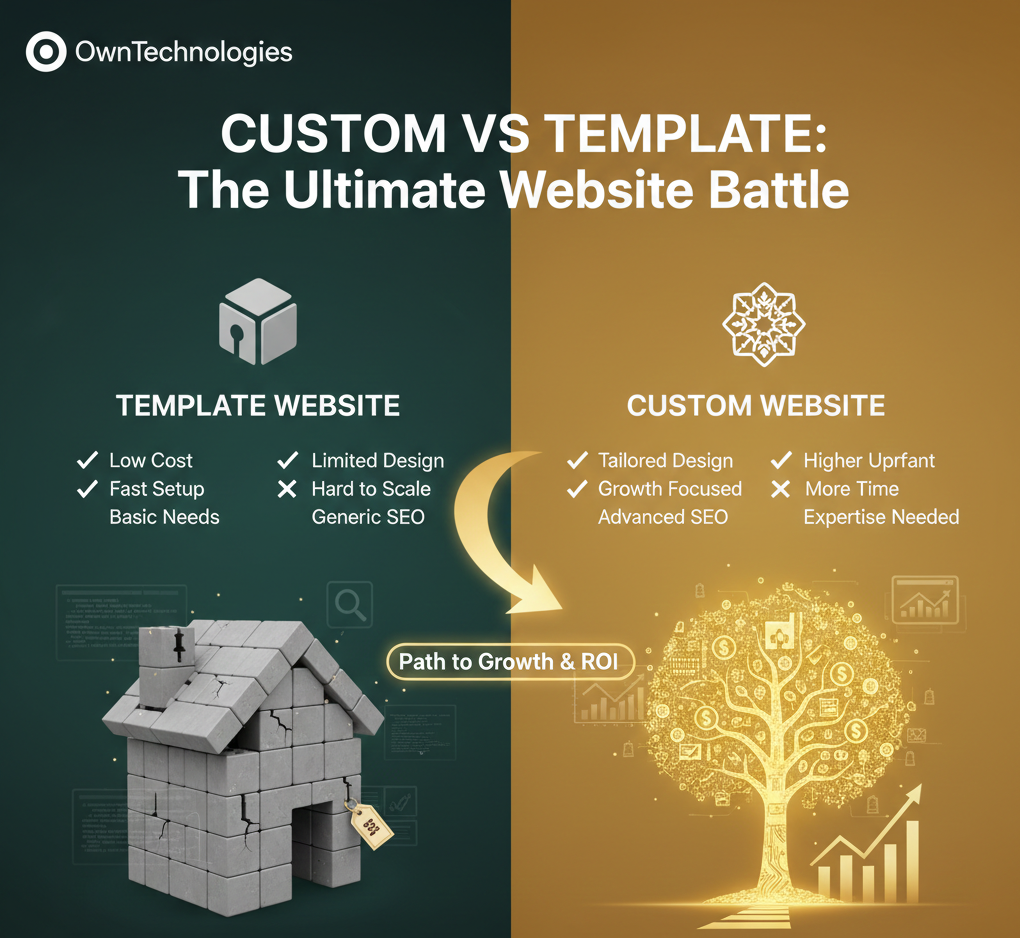
When building a website, one of the biggest decisions businesses face is choosing between a custom website and a template website.
Both options have advantages and limitations. The right choice depends on your business goals, budget, scalability needs, and long-term growth plans.
In this guide, we break down the pros, cons, costs, SEO impact, and real-world use cases to help you make the right decision.
What Is a Template Website?
A template website is built using pre-designed layouts and themes. These are ready-made structures that allow faster development with limited customization.
Template websites are commonly used by:
- Small businesses
- Startups
- Freelancers
- Budget-conscious companies
They are quick to launch but may lack flexibility.
What Is a Custom Website?
A custom website is designed and developed from scratch based on specific business requirements. It offers complete control over design, functionality, scalability, and performance.
Custom websites are ideal for:
- Growing businesses
- Enterprises
- E-commerce platforms
- Companies with unique workflows
They require more time and investment but provide long-term flexibility.
Custom Website vs Template Website – Key Differences
| Factor | Template Website | Custom Website |
|---|---|---|
| Cost | Lower upfront | Higher upfront |
| Development Time | Fast | Moderate to long |
| Design Flexibility | Limited | Fully customizable |
| Scalability | Restricted | Highly scalable |
| SEO Optimization | Basic | Advanced & structured |
| Performance | Moderate | Optimized |
| Uniqueness | Generic | Unique brand identity |
Pros and Cons of Template Websites
✅ Pros
- Lower development cost
- Faster launch time
- Easy setup
- Suitable for simple business needs
❌ Cons
- Limited customization
- Generic design
- SEO limitations
- Performance issues if overloaded
- Harder to scale long-term
Template websites work well for businesses that need a basic online presence quickly.
Pros and Cons of Custom Websites
✅ Pros
- Fully tailored to business goals
- Better SEO architecture
- Optimized performance
- Strong brand differentiation
- Scalable for future growth
❌ Cons
- Higher upfront investment
- Longer development time
- Requires professional expertise
Custom websites are built as long-term digital assets rather than quick solutions.
Cost Comparison – Custom Website vs Template Website
Template Website Cost
Typically lower because you’re using pre-built frameworks. Costs may include:
- Theme purchase
- Basic development
- Hosting
- Minor customization
Best for businesses with limited budgets.
Custom Website Cost
Higher because everything is designed and built specifically for your business. Costs may include:
- UI/UX design
- Frontend and backend development
- SEO optimization
- Performance tuning
- Custom integrations
While upfront cost is higher, long-term ROI is often stronger due to scalability and better conversion performance.
Which Is Better for SEO?
Custom websites generally perform better in SEO because:
- Clean code structure
- Faster loading speed
- Advanced technical SEO implementation
- Flexible content architecture
- Better internal linking structure
Template websites can rank, but optimization is often limited by structural constraints.
Which Option Is Right for Your Business?
Choose a template website if:
- You need a simple website quickly
- Your budget is limited
- Your functionality needs are basic
Choose a custom website if:
- You plan long-term growth
- You need scalability
- You require advanced features
- SEO and conversions are priorities
Your website should align with your business strategy—not just your budget.
Is Your Website Built for Growth or Just for Presence?
Choosing the wrong website structure can limit performance, SEO, and scalability.
Before making a decision, get clarity on what aligns with your business stage and growth plans.
👉 Schedule a quick strategy discussion with our team.
We’ll help you identify the smartest path forward.
📩 hello@owntechnologies.in
🌐 owntechnologies.in
Final Verdict
Template websites are good for starting.
Custom websites are built for scaling.
If your website is a critical growth driver, investing in a custom solution often delivers better long-term ROI.
The right decision depends on your goals, growth plans, and digital strategy.
Frequently Asked Questions
- Is a custom website better than a template website?
A custom website is better for businesses that require scalability, unique branding, and advanced SEO. Template websites are suitable for basic needs and limited budgets.
- Are template websites bad for SEO?
Template websites are not inherently bad for SEO, but they may have structural limitations that restrict advanced optimization compared to custom-built websites.
- How much does a custom website cost compared to a template website?
Custom websites typically cost more due to tailored design and development, while template websites are more affordable because they use pre-built frameworks.
- Which website type is better for long-term business growth?
Custom websites are generally better for long-term growth because they allow scalability, advanced features, and stronger brand positioning.
- Can a template website be converted into a custom website later?
Yes, but rebuilding or migrating from a template to a custom website may require redesign, restructuring, and additional investment.